Showing posts with label Grosz. Show all posts

Wednesday, August 4, 2010

George Grosz in America


I thought the war would never end. And perhaps it never did, either. George Grosz


George Grosz, The Wanderer, 1934

George Grosz was born Georg Groß in Berlin (1893), but changed his name in 1916 out of his hatred of Prussian militarism and a romantic enthusiasm for America. (His artist friend and collaborator Helmut Herzfeld changed his name to John Heartfield at the same time and for the same reasons).  Next to Otto Dix and Max Beckmann, Grosz was to become one of the most prominent artists of the Weimar Republic. I have illustrated this post with some of Grosz' later works.


George Grosz, Retreat (Rückzug), 1946

By 1933 Grosz's reputation as a political activist and deflator of German greatness was no secret. Menacing portents and premonitions of disaster began to haunt him. A studio assistant appeared in a brown shirt one day and warned him to be careful; a threatening note calling him a Jew was found beside his easel. A nightmare he recounted in his autobiography ended with a friend shouting at him "Why don't you go to America?" When in the spring of 1932 a cable arrived from the Art Students League in New York, inviting him to teach there during the summer, he accepted immediately. 


 George Grosz, The Painter of the Hole II, 1950

After a short return to Germany, where he was advised that his apartment and studio had been searched by the Gestapo, who were looking for him, Grosz emigrated to New York in January 1933. He became a naturalized citizen of the United States in 1938, and made his home in Bayside, New York. Meanwhile, Grosz was among the defamed artists whose works had been included in two Schandausstellungen (abomination exhibitions) in Mannheim and Stuttgart in 1933. 


 George Grosz, Remembering (Self-Portrait), 1936

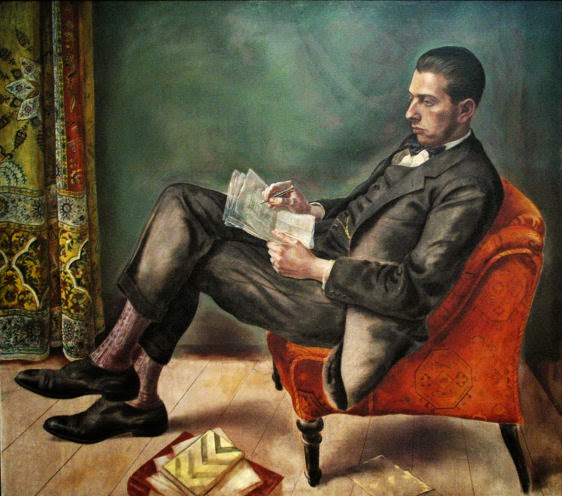
The polemical articles about modern art, "art on the edge of insanity" as the official Nazi newspaper, the Völkischer Beobachter called it, also regularly included Grosz. A portrait of the poet Max Hermann-Neisse, later to appear in the exhibition Entartete Kunst (Degenerate Art), was singled out for the "degenerate loathsomeness of the subject". A total of 285 of Grosz's works were removed from German museums and either burnt or sold abroad.


 George Grosz, God of War, 1940

The heirs of George Grosz filed suit in New York in 2009 against the Museum of Modern Art for refusing to return three artworks created by Grosz and left behind by him when he fled Germany in 1933. The artworks, including a portrait of the poet Max Herrmann-Neisse were left behind with his Galerist Alfred Flechtheim. Flechtheim died 1937 in London, having also been exiled from Germany. Flechtheim's wife, Betty, stayed on in Germany not having raised the necessary funds to pay Jewish taxes in order to obtain permission to leave. 


 Georg Grosz, The Poet Max Herrmann-Neisse, 1927

Betty Flechtheim eventually committed suicide in 1941 after having been given notice that she would be sent to a concentration camp. Shortly after Flechtheim's death, Charlotte Weidler, an art dealer and curator for the Carnegie Institute, claimed she had "inherited" paintings from him including the Max Herrmann-Neisse painting. However, the latter belonged to George Grosz who had never given up its ownership. After WWII, in 1949 Weidler brought the painting to New York where she sold it to MoMA in 1952. 


George Grosz, Myself and the Barroom Mirrror, 1937

At the time, George Grosz was living in New York but was not informed of the sale. He continued to exhibit regularly, opened a private art school at his home and taught at the Art Students League intermittently until 1955. In 1946 Grosz had published his autobiography, A Little Yes and a Big No. There he wrote: "A great deal that had become frozen within me in Germany melted here in America and I rediscovered my old yearning for painting. I carefully and deliberately destroyed a part of my past."  


 George Grosz, Female Nude in the Dunes of Cape Cod, 1938

In a letter sent to John Heartfield in 1946, Grosz was notably low key, writing that his European fame now ultimately boiled down to "a card-box container full of newspaper clippings - nothing more". Grosz talked of his having given art lectures at Columbia University and at other institutions, and of doing some illustrations which had brought him "a little fame." But this was, he observed sadly, "not enough to make a living from."


 Anom., George Grosz painting "Cain or Hitler in Hell", New York, 1944

Grosz returned to Germany permanently in 1958, somewhat disillusioned with his American interlude. He was appreciated in America primarily as a satirist, and the work from the period after the First World War was perceived as his best. Grosz was unable to understand the American psyche to the degree that he had the German, and he returned to Berlin in an attempt to regain the momentum he had lost. Six weeks later, at Savigny Platz 5, Grosz died toppling down a flight of stairs after a boozy night out drinking.

Saturday, July 10, 2010

Painting Holes


That the most important things are done through tubes. Evidence: first, the reproductive organs, the pen and our gun (Georg Christoph Lichtenberg, Sudelbücher, 1770)
 
 
 Troops of the Kapp-putschists on Potsdamer Platz, Berlin

During street-fighting in Dresden during the 1920 right-wing Kapp Putsch, a shot fired by defending workers damaged Rubens' painting Bathsheba.  Ignoring the casualties (35 workers were killed and 151 wounded in the fighting) Oscar Kokoschka distributed a leaflet to defend the Rubens, beseeching the workers to fight elsewhere, because "the saving of such elevating works of art was in the end much greater than any political action.


Franz W. Seiwert, Klassenkampf (Class warfare), 1922. Published in the radical newspaper, Die Aktion.

The progressive artist Frans Seiwert responded immediately: "Rubens' art had long been dead. For a few hundred years we have had enormous holes in gigantic frames. Such art paralysed the will of the present generation: it weighs heavily on us and prevents us from acting". 


 Eva Švankmajerová, The making of a hole, 1987 

Eleven years later, in an 1931 article for Die Weltbühne ("The Social Psychology of Holes"), Kurt Tucholsky found a kind of dialectic solution: 

"The hole is a permanent companion of the non-hole; I'm sorry, but there is no such thing as a hole in itself. If there were something everywhere, there would be no holes, but there wouldn't be any philosophy either, not to mention religion, which is holey in origin. A mouse couldn't exist without a hole, nor could man. It is the final salvation for both when they are hard-pressed by matter. A hole is always a Good Thing."


Philippe Rousseau, The Rat Who Withdrew From The World, 1885

 George Grosz, The Painter of the Hole I, 1948

Mark Tansey, Discarding The Frame, 1980s

Saturday, June 26, 2010

Felix José Weil

 George Grosz, Portrait of Felix. J. Weil, 1926

Felix José Weil (1898-1975) was the original financial provider for the Institute for Social Research in Frankfurt am Main, Germany. The Institut later earned worldwide recognition by the works of, among others,  Theodor W. Adorno, Max Horkheimer and Jürgen Habermas. Weil was born in Buenos Aires, Argentina and was the son of the wealthy German-Jewish merchant Hermann Weil and his wife Rosa Weil. At the age of 9 he was sent to attend school in Frankfurt. He went on to attend the universities in Tübingen and Frankfurt, where he graduated with a doctoral degree in political science. While at these universities he became increasingly interested in Marxism. 


Participants of the 1923 Marxist Work Week: Friedrich Pollock (above, 2. from left), Georg Lukács (above, 4. from left), Felix Weil (above, 2. from right).

In 1923 Felix Weil financed the First Marxist Work Week (Erste Marxistische Arbeitswoche) in the German town of Ilmenau. The event was attended by figures such as Georg Lukács, Karl Korsch and Friedrich Pollock. Based on the success of this event he went on, along with his friend Friedrich Pollock, to found the Institute for Social Research in 1924 which he financed with a large part of his heritage. Describing himself later as a "Salon Bolshevik", Weil also supported left-wing artists like George Grosz whom he financed a trip to Italy. Since 1945 Weil permanently lived in California.  

 You can read more about Felix Weil here (page 11 ff).

Monday, June 21, 2010

Murderer, The Hope of Women

 Oskar Kokoschka, Murderer, The Hope of Women, 1909

How can a murderer be the hope of women - or of men, for that matter? And what have hope and murder of women to do with art? In his memoir Oskar Kokoschka, who was known more for his visual art than for his theatrical experiments, tells us that "art gives renewed hope as often as the world fails"; and insists that the answer is not in words per se but in the experience of the performance. 


 Oskar Kokoschka, Poster for "Murderer, the Hope of Women" (Vienna Summer Theatre), 1909

Originally staged in Vienna in 1909, Murderer, The Hope of Women is generally regarded as the first Expressionist play. Its obsession with sex and death is expressed in grand gestures and archaic language, while its physical risks, and its chants and screams, so vividly presaged the theories and plays of Antonin Artaud that it could almost be called a paradigm of the Theatre of Cruelty. 


 Heinrich Maria Davringhausen, Der Lustmörder (The Ripper), 1917

When Kokoschka’s play was performed, it was met with considerable criticism and controversy. Its extreme visual aspects, with its dramatic and disturbing costumes and violent imagery, made it the first expressionist drama for many critics. The playwright Paul Kornfeld praised the revolutionary drama as a breakthrough art form, calling it a “verbally supported pantomime”. Similarly, drama critic Walter Sokel admired the work’s departure from traditional realism and its exploration into the surrealism underlying its biblical and mythical allusions

 George Grosz, John, the Lady Killer, 1918

Many interpreted the play as an effective theatrical portrayal of Otto Weininger’s idea of gender relations as a battle between man and woman. According to Weininger, Sexuality was a conflict between superior male spirituality and debased female bestiality. Otto Weininger was widely read at that time, and it might well be that he also had some influence on this early Otto Müller painting:


 Otto Müller, Standing Nude with Dagger, 1903


By the way, there is a nice song by Momus with the same title. Don't miss it.