
Archangelsk 1941, [Margaret Bourke White with her husband, author Erskine Caldwell]
All photo comments [except those in square brackets] by Margaret Bourke-White
Margaret Bourke-White was born in New York City in 1904. She became interested in photography while studying at Cornell University. After studying photography under Clarence White at Columbia University she opened a studio in Cleveland where she specialized in architectural photography. In 1929 Bourke-White was recruited as staff photographer for Fortune Magazine. She made several trips to the Soviet Union and in 1931 published Eyes on Russia. Deeply influence by the impact of the Depression, she became increasingly interested in politics. In 1936 Bourke-White joined Life Magazine and her photograph of the Fort Peck Dam appeared on its first front-cover.

In 1937 Bourke-White worked with the best-selling novelist, Erskine Caldwell, on the book You Have Seen Their Faces (1937). The book was later criticised for its left-wing bias and upset whites in the Deep South with its passionate attack on racism. Bourke-White was a member of the American Artists' Congress. The group supported state-funding of the arts, fought discrimination against African American artists, and supported artists fighting against fascism in Europe. Bourke-White also subscribed to the Daily Worker and was a member of several Communist Party front organizations.

Bourke-White married Erskine Caldwell in 1939 and the couple were the only foreign journalists in the Soviet Union when the German Army invaded in 1941. Bourke-White and Caldwell returned to the United States where they produced another attack on social inequality, Say Is This the USA? (1942). During the Second World War Bourke-White served as a war correspondent, working for both Life Magazine and the U.S. Air Force. Bourke-White, who survived a torpedo attack while on a ship to North Africa, was with United States troops when they reached the Buchenwald Concentration CampAfter the war Bourke-White continued her interest in racial inequality by documenting Gandhi's non-violent campaign in India and apartheid in South Africa.

The FBI had been collecting information on Bourke-White's political activities since the 1930s and in the 1950s became a target for Joe McCarthy and the Un-American Activities Committee. However, a statement reaffirming her belief in democracy and her opposition to dictatorship of the left or of the right, enabled her to avoid being cross-examined by the committee. In 1952 Bourke-White was discovered to be suffering from Parkinson's Disease. Unable to take photographs, she spent eight years writing her autobiography, Portrait of Myself (1963). Margaret Bourke-White died at Darien, Connecticut, in 1971.


Magnitogorsk 1931
Under-construction blast furnace (world's largest) at Magnitogorsk Metallurgical Industrial Complex
In 1937 Bourke-White worked with the best-selling novelist, Erskine Caldwell, on the book You Have Seen Their Faces (1937). The book was later criticised for its left-wing bias and upset whites in the Deep South with its passionate attack on racism. Bourke-White was a member of the American Artists' Congress. The group supported state-funding of the arts, fought discrimination against African American artists, and supported artists fighting against fascism in Europe. Bourke-White also subscribed to the Daily Worker and was a member of several Communist Party front organizations.

Stalingrad 1931
Closeup portrait of Russian iron puddler w. glasses parked over his brow, at the "Red October" Rolling Mills.
Closeup portrait of Russian iron puddler w. glasses parked over his brow, at the "Red October" Rolling Mills.

Dnieiperstoi, 1931
Col. Hugh Cooper, formerly of the US Army Corps of Engineers, posing in front of Russia's Dnieper River Dam, the largest in the world for which he was the chief consultant for its construction.
Col. Hugh Cooper, formerly of the US Army Corps of Engineers, posing in front of Russia's Dnieper River Dam, the largest in the world for which he was the chief consultant for its construction.
The FBI had been collecting information on Bourke-White's political activities since the 1930s and in the 1950s became a target for Joe McCarthy and the Un-American Activities Committee. However, a statement reaffirming her belief in democracy and her opposition to dictatorship of the left or of the right, enabled her to avoid being cross-examined by the committee. In 1952 Bourke-White was discovered to be suffering from Parkinson's Disease. Unable to take photographs, she spent eight years writing her autobiography, Portrait of Myself (1963). Margaret Bourke-White died at Darien, Connecticut, in 1971.

Magnitogorsk 1931
Two Russian workers running a drill press in a machine shop
 Moscow 1931
Closeup portrait of a Russian Orthodox priest
 Siberia 1931
Closeup portrait of Tovarisch Mikhail, a Siberian bricklayer
 Tiflis 1931
Closeup portrait of Stalin's mother, Ekaterina Dzhugashvili
 Moscow 1931
Russian Communist Karl B. Radek holding pipe at home
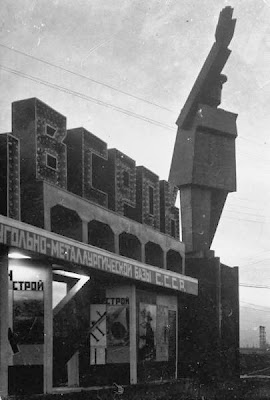 Magnitogorsk 1931
Silhouette at twilight of gigantic sculptured rendition of a Russian robot w. hand raised in a salute next to unident. bldg
 Moscow 1931
Unident. Russian public bldg.
[Rusakov Workers' Club by Konstantin Melnikov]
 Moscow 1931
Russian men dressed in tunics standing on the steps of a Workers Club
 Moscow 1931
Unident. Russian public bldg.
[Mosselprom building]
 Siberia 1931
Russian woman grimly holding a slab of meat as other peasant women staunchly stand by
 Magnitogorsk 1931
Russian peasant riding a hay wagon in Siberia
 Moscow 1941
US envoy Harry Hopkins standing w. Soviet leader Joseph Stalin during their meeting.
 Gori, 1941
Peasant home which was the birthplace of Russian Communist dictator Joseph Stalin, standing encased as a monument in magnificent marble like some sacred relic shrine, in the Socialist Soviet Republic of Georgia.
 Moscow 1941
Russian women's brigade wielding crude rakes to gather up hay harvest on a collective farm outside the capitol.
 Moscow 1941
Russian kindergarten boys clad in miniature caps w. red stars, aiming toy rifles, barricaded behind classroom furniture, while playing war game.
 Kislovodsk 1941
Russian reading a book on park bench.
 Near Moscow 1941
Russian women's brigade members leaning out open windows of house, criss-crossed w. tape to keep them fr. breaking during air raid, on grounds of collective farm nr. nr. Moscow.
 Moscow 1941
Locomotive named Stalin is studied by students at the Locomotive Laboratory of the Technical Institute as top instructors (L) wearing enameled red decorative pins, lecture on its mechanics.
 Moscow 1941
Students fr. a variety of races incl. Tartar, Turkman, Armenian, Jewish & German, listening to lecture in Greek history at the Moscow University in a country where there are more Nordics than in Germany.
 Moscow 1941
Russian post-grad students in economics & philosophy, hard at work on their respective theses at the Lenin Library, one of the largest in the world.
 Russia 1941
Russian woman using an abacus to calculate numbers in business.
 Moscow 1941
All-Union Council of Evangelists & Baptists Pres. Orlav, onetime atheist and psycho-neurologist student, at altar administering communion, at reformist church used by Baptists.
 Moscow 1941
Reception room at the Communist Party daily newpaper PRAVDA where women are writing letters of complaint which they will submit, re insufficient housing & too much red tape on their job & an unpublished genius reading the newpaper wants his works published.
 Moscow 1941
Russian who during working hours is a chef in a large restaurant, enjoying a Cowboy cocktail consisting of an egg yolk, gin, apricot liqueur, benedictine & a peppery liqueur at the Cocktail Hall, the only cocktail bar in the city.
 Moscow 1941
Commuters moving along arched Metro subway platform complete w. mosaic inlaided designs between light fixtures & the ceiling, representing airplanes, Kremlin Towers etc. in station at Mayakovsky Square.
 Moscow, July 26, 1941
Overall of central Moscow w. antiaircraft gunners dotting sky over Red Square w. exploding shells w. spires of Kremlin silhouetted by German Luftwaffe flare.
 Moscow 1941
Exhausted Russian city workers occupying a bomb shelter during air raid drill at typical apartment house after a hard day's work.
 Vyazma, 1941
German airmen (L-R) Josef Trocha, Walther Rasek, & Rudolph Tause, shot down over Russia & now being interrogated by American correspondents near the Russian front.
 Moscow 1941
German soldier Rolf Helmudt lying in a Russian hospital after being wounded in action at the front.
 Russia 1941
Portrait of two Russian infantrymen marching in formation
Two Russian workers running a drill press in a machine shop

Closeup portrait of a Russian Orthodox priest

Closeup portrait of Tovarisch Mikhail, a Siberian bricklayer

Closeup portrait of Stalin's mother, Ekaterina Dzhugashvili

Russian Communist Karl B. Radek holding pipe at home

Silhouette at twilight of gigantic sculptured rendition of a Russian robot w. hand raised in a salute next to unident. bldg

Unident. Russian public bldg.
[Rusakov Workers' Club by Konstantin Melnikov]

Russian men dressed in tunics standing on the steps of a Workers Club

Unident. Russian public bldg.
[Mosselprom building]

Russian woman grimly holding a slab of meat as other peasant women staunchly stand by

Russian peasant riding a hay wagon in Siberia

US envoy Harry Hopkins standing w. Soviet leader Joseph Stalin during their meeting.

Peasant home which was the birthplace of Russian Communist dictator Joseph Stalin, standing encased as a monument in magnificent marble like some sacred relic shrine, in the Socialist Soviet Republic of Georgia.

Russian women's brigade wielding crude rakes to gather up hay harvest on a collective farm outside the capitol.

Russian kindergarten boys clad in miniature caps w. red stars, aiming toy rifles, barricaded behind classroom furniture, while playing war game.

Russian reading a book on park bench.

Russian women's brigade members leaning out open windows of house, criss-crossed w. tape to keep them fr. breaking during air raid, on grounds of collective farm nr. nr. Moscow.

Locomotive named Stalin is studied by students at the Locomotive Laboratory of the Technical Institute as top instructors (L) wearing enameled red decorative pins, lecture on its mechanics.

Students fr. a variety of races incl. Tartar, Turkman, Armenian, Jewish & German, listening to lecture in Greek history at the Moscow University in a country where there are more Nordics than in Germany.

Russian post-grad students in economics & philosophy, hard at work on their respective theses at the Lenin Library, one of the largest in the world.

Russian woman using an abacus to calculate numbers in business.

All-Union Council of Evangelists & Baptists Pres. Orlav, onetime atheist and psycho-neurologist student, at altar administering communion, at reformist church used by Baptists.

Reception room at the Communist Party daily newpaper PRAVDA where women are writing letters of complaint which they will submit, re insufficient housing & too much red tape on their job & an unpublished genius reading the newpaper wants his works published.

Russian who during working hours is a chef in a large restaurant, enjoying a Cowboy cocktail consisting of an egg yolk, gin, apricot liqueur, benedictine & a peppery liqueur at the Cocktail Hall, the only cocktail bar in the city.

Commuters moving along arched Metro subway platform complete w. mosaic inlaided designs between light fixtures & the ceiling, representing airplanes, Kremlin Towers etc. in station at Mayakovsky Square.

Overall of central Moscow w. antiaircraft gunners dotting sky over Red Square w. exploding shells w. spires of Kremlin silhouetted by German Luftwaffe flare.

Exhausted Russian city workers occupying a bomb shelter during air raid drill at typical apartment house after a hard day's work.

German airmen (L-R) Josef Trocha, Walther Rasek, & Rudolph Tause, shot down over Russia & now being interrogated by American correspondents near the Russian front.

German soldier Rolf Helmudt lying in a Russian hospital after being wounded in action at the front.

Portrait of two Russian infantrymen marching in formation




 Posts
Posts


